

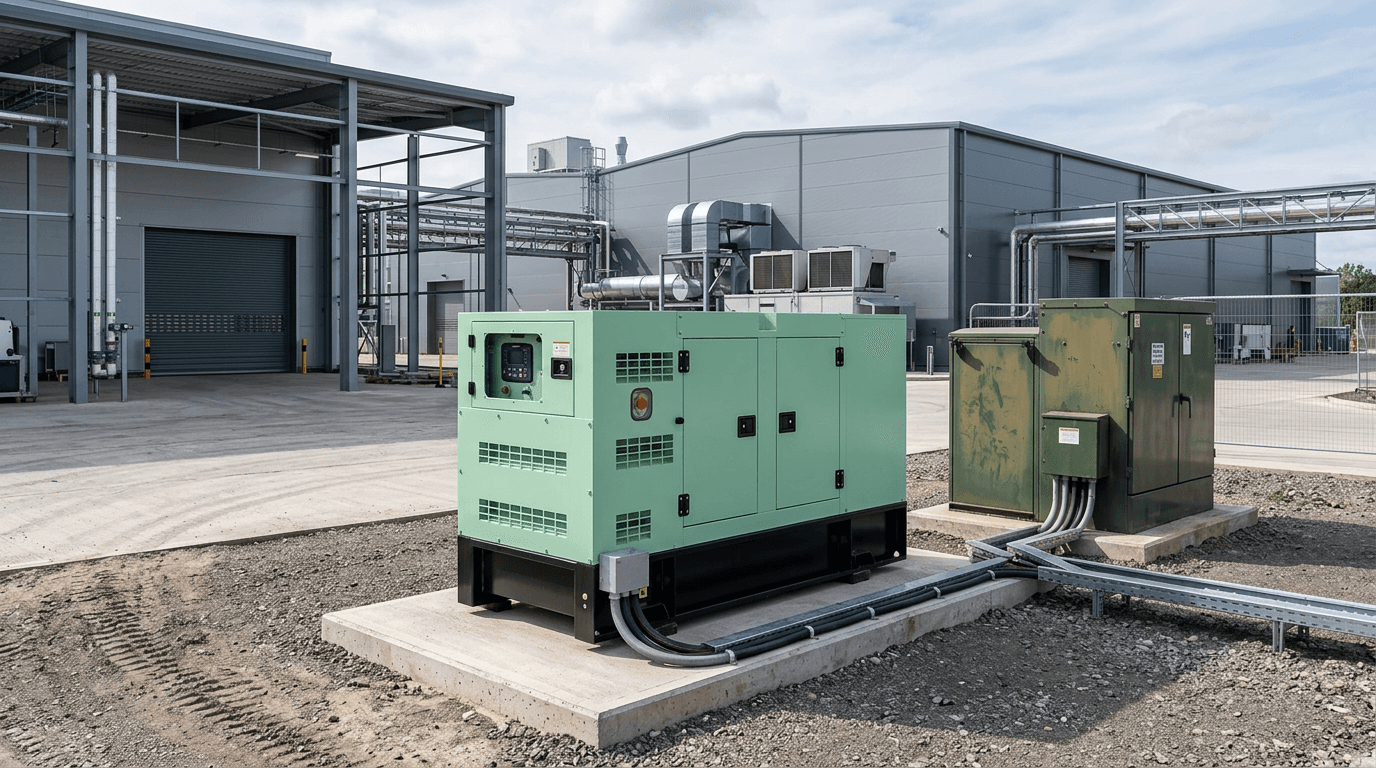
Most companies view diesel generators as insurance—expensive equipment that sits idle 99% of the time, waiting for the rare power outage. But what if that generator could earn revenue while it waits?
Production-grade generators can participate in ancillary services markets, providing grid stability reserves and earning capacity payments. For companies already planning a generator investment, the question becomes: is the incremental cost of upgrading to a production-grade unit worth the revenue potential?
In this article, you'll learn:
The key differences between backup and production-grade generators
Which ancillary services generators can participate in
The technical and regulatory requirements for grid-connected operation
How to evaluate the economics and payback period
When this investment makes sense—and when it doesn't
The Backup Generator as a Stranded Asset
A typical backup generator runs perhaps 50-100 hours per year—monthly test runs plus occasional outages. That's a significant capital investment generating zero return for 99% of its operational life.
Production-grade generators change this equation. Instead of sitting idle, they can be registered with the transmission system operator (TSO) to provide frequency reserves. When called upon—which may be rarely—they help stabilize the grid. More importantly, they earn capacity payments simply for being available.
The catch: production-grade generators cost significantly more, require additional equipment, and need regulatory approval. The decision comes down to whether the incremental investment pays back within an acceptable timeframe.
Backup vs. Production-Grade Generators: What's the Difference?
Standby (Backup) Generators
Designed for emergency use during utility outages
Typically rated for ~200 hours/year maximum runtime
Air-cooled designs common in smaller units
Service intervals every 50-100 hours
Not designed for frequent starts or extended operation
Quick and relatively simple to install
Production-Grade (Prime Power) Generators
Built for continuous or frequent operation
Unlimited runtime capability
Liquid cooling systems for sustained operation
Service intervals of 250-500 hours
10% overload capability (1 hour out of 12)
Requires DSO involvement and approval for grid connection
The cost difference is substantial. Upgrading from a standby generator to a production-grade unit can nearly double the total investment. This includes not just the generator itself, but also Stage V emissions compliance, synchronization equipment, more complex control systems and documentation towards the DSO.
How Generators Participate in Ancillary Services
The Revenue Model
Revenue from ancillary services comes in two forms:
Capacity Payments (Primary Revenue) You're paid for being available to provide reserves, regardless of whether you're actually activated. You bid your available capacity (in MW) for hourly intervals, and if your bid clears, you receive the capacity payment. This is where most generator revenue comes from.
Energy Payments (Secondary Revenue) If the TSO actually activates your generator, you receive an additional payment for the energy delivered. However, activation is rare—typically only when energy prices spike very high (around DKK 2,500/MWh or more in Denmark).
Which Markets Can Generators Access?
Diesel generators are too slow to participate in fast-response frequency containment reserves (FCR). Instead, they qualify for:
aFRR (Automatic Frequency Restoration Reserve)
Full activation time: 5 minutes¹
Standardized product duration: 15 minutes
Automated activation based on frequency deviation signal
Primary market for generator participation
mFRR (Manual Frequency Restoration Reserve)
Activation within 12.5-15 minutes¹
Manual activation by TSO
15-minute activation signal duration
DK1 vs. DK2: Market Differences
Denmark operates two electricity bidding zones with different characteristics:
Factor | DK1 (Western) | DK2 (Eastern) |
|---|---|---|
Grid connection | Continental Europe | Nordic synchronous |
aFRR market | Since October 2024 | Since December 2022 |
Activation frequency | Lower | Higher |
Typical payback | ~3 years | ~2 years |
DK2 generally offers faster payback due to higher activation frequency and market maturity, if we look at the historic activation pattern.
Requirements for Grid-Connected Operation
Connecting a production-grade generator to the grid requires meeting several technical and regulatory requirements.
Prequalification with Energinet
All units must pass Energinet's prequalification process:
Technical tests demonstrating required response characteristics
Frequency measurement capability (1-second resolution)
Reevaluation required at minimum every 5 years¹
Grid Connection (RfG Compliance)
Under EU Regulation 2016/631 (Requirements for Generators):
Type B requirements apply for units ≥125kW in Denmark
Must be approved by relevant regulatory authority
Remote control capability required for production ≥125kW connected after April 2019
Synchronization Equipment
Essential equipment for grid-parallel operation:
Parallel Controller — monitors parameters of both grid and generator
Auto-Synchronizer — adjusts generator speed and voltage
Synchronism-Check Relay (Device 25) — permits breaker closure only within safe parameters
Reverse Power Relay (Device 32) — protects against motorizing
Synchronization parameters must be within tight tolerances:²
Voltage difference: less than 5%
Frequency difference: less than 0.2 Hz
Phase angle: less than 5 electrical degrees
Stage V Emissions Compliance
Production-grade generators (non-emergency use) must meet EU Stage V emissions standards:³
Requires diesel particulate filter (DPF)
Requires diesel oxidation catalyst (DOC)
Emergency stationary generators are exempt—but production generators are not
Many generators don't comply out-of-the-box. Premium European suppliers typically offer compliant units, but this adds to cost.
DSO Approval Process
Unlike backup generator installation, production generators require DSO involvement:
Contact local DSO to request power availability information
DSO assesses capacity at your connection point
Technical assessment (noise, grid stability impact)
Approval for injection at specific point of connection
Timeline: 6-24 months from initial inquiry to commissioning
Risk: There is a genuine possibility of not receiving approval, particularly if:
Insufficient export capacity at your connection point
Noise requirements cannot be met
Grid stability concerns at your location
Economics: Incremental Cost vs. Revenue Potential
The Investment Decision
If you're already planning to purchase a backup generator, the question is whether the incremental cost of upgrading to production-grade justifies the revenue.
Incremental Costs:
Production-grade generator premium (can nearly double base cost)
Stage V emissions compliance (DPF, DOC)
Synchronization equipment
DSO approval process (time and fees)
Aggregator control system fees
Increased maintenance (more frequent operation)
Revenue:
Capacity payments (primary—paid for availability)
Energy payments (secondary—rare activation)
Payback Period
Based on current market conditions:
DK2: Approximately 2 years
DK1: Approximately 3 years (less frequent activation)
Important caveats:
Capacity payment rates can change—they're strong now but could decline
Market risk exists; extended payback periods are possible
Individual project economics vary based on size, location, and grid customer status
Fuel Costs When Activated
Typical diesel generator fuel consumption:⁴
Approximately 0.3-0.5 liters per kWh at efficient load
Around 200-210g/kWh at 75% load
Most efficient operation at 70-80% of rated load
Since most revenue comes from capacity payments (not activation), fuel costs are relatively minor. When activation does occur, energy prices are typically high enough (DKK 2,500+/MWh) to cover fuel costs with margin.
When NOT to Upgrade to a Production-Grade Generator
This investment doesn't make sense in every situation. Consider these disqualifying factors:
Hard Stops
Grid connection below 300kW — Economics don't typically work at smaller scales
No export headroom — If your connection has no available export capacity, you can't inject power
Non-B-low customer classification — You may need to purchase export rights, adding cost and complexity
Zero-emissions mandate — If your company policy prohibits diesel operation for non-emergency purposes
DSO rejection risk too high — If preliminary discussions suggest approval is unlikely
Yellow Flags
Retrofitting existing generator — Starting fresh is usually more economical than upgrading
Low risk tolerance — Market conditions can change; capacity payments could decline
DK1 location — Longer payback than DK2; evaluate if 3-year payback is acceptable
Complex operational environment — If frequent genuine outages mean your generator is often in backup mode
Decision Checklist
Factor | Favorable | Unfavorable |
|---|---|---|
Grid connection capacity | ≥300kW | <300kW |
Export headroom | Available | None |
Customer classification | B-low (can export) | Non-B-low |
Location | DK2 | DK1 |
Existing generator | None (new purchase) | Already installed |
Environmental policy | Accepts occasional operation | Zero-emissions |
Risk tolerance | Comfortable with market risk | Needs guaranteed returns |
Next Steps: Evaluating Your Situation
If this investment looks potentially viable, here's the implementation path:
1. Gather Site Data
Current grid connection capacity
Average and peak load profile
Available export headroom
Grid customer classification (B-low status)
2. Preliminary DSO Discussion
Before committing to a production-grade purchase, have an informal discussion with your DSO about:
Likelihood of approval at your connection point
Known constraints (noise, capacity, stability)
Estimated timeline and process
3. Get Generator Quotes
Compare standby vs. production-grade pricing for your capacity needs
Confirm Stage V compliance
Include synchronization equipment costs
4. Model the Economics
Calculate incremental cost (production vs. standby)
Estimate revenue based on current capacity payment rates
Sensitivity analysis for declining capacity payments
Determine acceptable payback period
5. Engage an Aggregator
Production generators require control systems that can respond to market signals. Aggregators typically provide:
Control system integration
Market bidding and optimization
Prequalification support
We highly recommend engaging with a company (such as Auxilium) that can advise on the best approach as early as possible in the process.
Conclusion
Upgrading to a production-grade generator can transform a backup asset into a revenue-generating one. For companies with grid connections of 300kW or above, favorable customer classification, and tolerance for some market risk, payback periods of 2-3 years are achievable in the Danish market.
However, this isn't a straightforward decision. The DSO approval process takes 6-24 months with genuine approval risk. The incremental investment is substantial. And market conditions can change.
The smart approach: Work with an advisor before purchasing to confirm your grid connection can support export, your customer classification allows injection, and the DSO is likely to approve. This due diligence costs far less than discovering these barriers after you've already bought the generator.
Ready to evaluate whether a production-grade generator makes sense for your facility?
Contact Auxilium for a free assessment. We'll review your grid connection, customer classification, and site constraints to determine if this investment path is viable before you commit to a purchase.
FAQ
Q: Can I upgrade my existing backup generator to participate in ancillary services? A: Generally not practical. Existing backup generators typically lack the operational rating, emissions compliance, and control systems required. Replacement is usually more cost-effective than retrofitting.
Q: How often will my generator actually run? A: Most revenue comes from capacity payments—being available, not running. Actual activation is rare, typically only when energy prices spike. Expect very limited running hours beyond testing.
Q: What happens if I can't respond when activated? A: Failure to deliver when called can result in penalties and potential loss of prequalification. Reliable fuel supply and maintenance are essential.
Q: Does the generator need to run continuously? A: No. It needs to be available and able to start and synchronize within the required activation time (5 minutes for aFRR, 12.5-15 minutes for mFRR).
Q: What if capacity payment rates decline? A: This is a real risk. Current rates are favorable, but markets can change. Conservative financial modeling should include scenarios with reduced capacity payments.
Q: Can I still use the generator for backup if it's providing grid services? A: Yes, but availability requirements mean you must be able to respond to activation signals. If you're already running on backup due to an outage, you wouldn't be available for grid services during that period.
Q: How do I find out my grid customer classification? A: Contact your DSO. Your classification determines whether you can export to the grid or need to purchase injection rights.
Sources
Energinet: Prequalification of Units and Aggregated Portfolios — View source
[Tier 1]React Power: Parallel Generators: Load Sharing & Synchronization — View source
[Tier 2]Diesel Net: EU Nonroad Engine Emission Standards — View source
[Tier 2]Generator Source: Diesel & Natural Gas Generator Fuel Consumption Charts — View source
[Tier 3]
Source tiers: [Tier 1] = TSO/regulatory documents. [Tier 2] = Industry/academic sources. [Tier 3] = Vendor content.