

If you're planning a solar farm, data center, battery installation, or industrial electrification project in Denmark, you've likely discovered an uncomfortable truth: securing a grid connection may now be harder than financing the project itself.
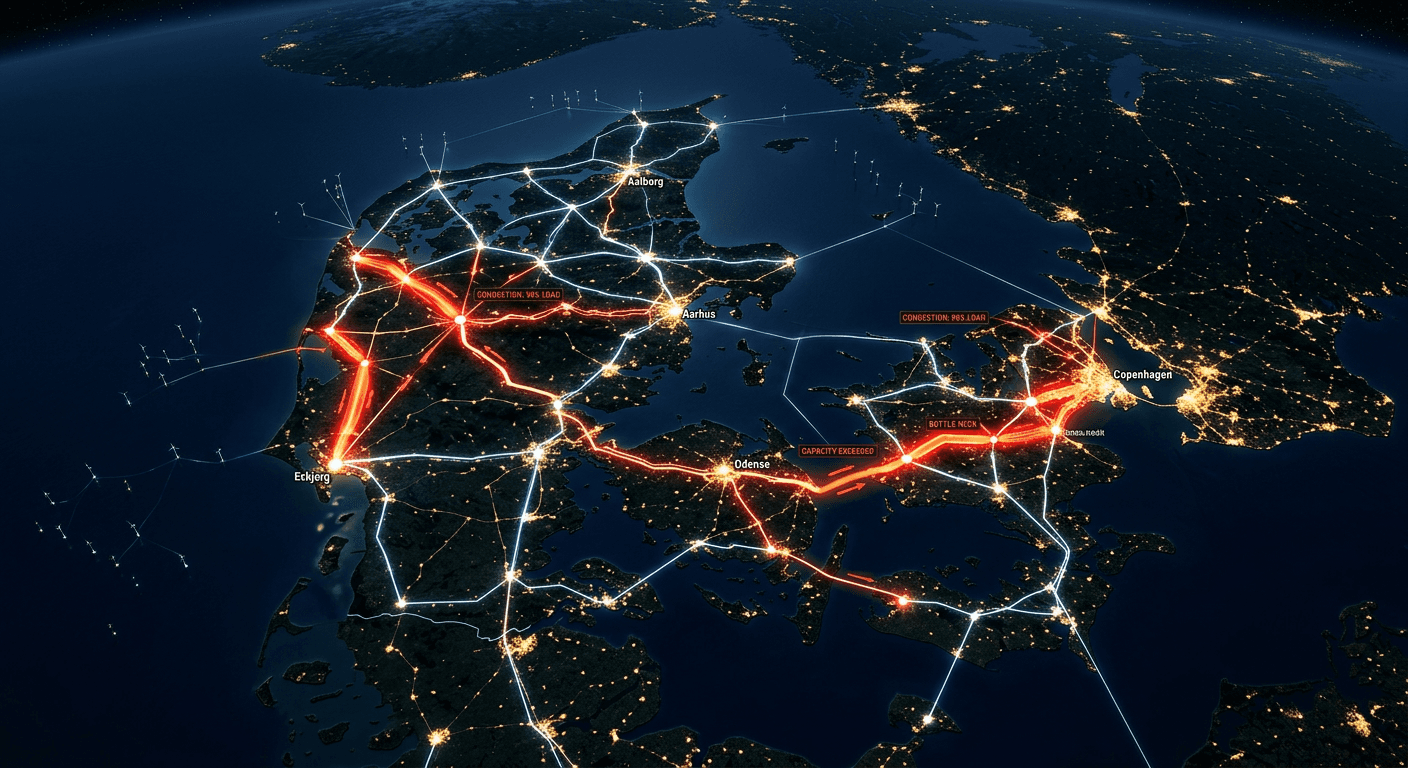
In March 2026, Energinet—Denmark's transmission system operator—halted all new grid connections.¹ The reason: approximately 60 GW of projects are waiting in the queue, nearly 10 times Denmark's peak electricity consumption of roughly 7 GW.
This article explains:
What caused the grid capacity crisis
How long connections might take
What the Netherlands and UK can teach us about what comes next
What this means for your projects and existing grid assets
The New Bottleneck: Why Grid Connections Are Harder to Get Than Financing
Denmark has entered a period where grid access—not capital, not permits—may be the binding constraint for energy projects.
The numbers tell the story:
60 GW of projects waiting for grid connections¹
~7 GW peak electricity consumption in Denmark¹
28,400 MW in new connection requests during 2025 alone²
This isn't a temporary backlog. It's a structural mismatch between the pace of electrification and the pace of infrastructure expansion.
Energinet's pause, announced in March 2026, applies to all new projects for at least three months "or until there is a comprehensive overview of the consequences of current demand and new measures have been implemented to increase capacity."¹ Existing connection agreements continue, and residential customers aren't affected.
But for developers of large-scale projects, the message is clear: the era of straightforward grid access is over.
The Electrification Wave Driving Connection Demand
What made demand grow so fast? Energinet cited that electrification happened "much faster than expected," specifically highlighting that "the scope of new large-scale consumption projects such as data centres, batteries, and Power-to-X facilities could not have been foreseen."¹
The demand comes from multiple sectors simultaneously:
Data centers require tens to hundreds of megawatts of high-utilization capacity. Unlike intermittent loads, data centers draw power continuously, stressing baseload infrastructure.
Battery storage parks need grid connections for both charging (consumption) and discharging (export), often requiring bidirectional capacity that wasn't anticipated in grid planning.
Power-to-X facilities for hydrogen and e-fuels production represent entirely new demand categories that didn't exist in previous infrastructure plans.
Solar and wind farms continue to expand rapidly, but they also need grid access to export power—and in some cases, DSO substations are already at capacity.
Industrial electrification as manufacturing shifts from gas-fired processes to electric alternatives creates new demand at existing industrial sites.
EV charging infrastructure, particularly high-power charging hubs, adds concentrated demand at specific grid points.
Each of these sectors grew faster than infrastructure planners projected. Combined, they overwhelmed the system.
How the Danish Grid Works: TSO vs. DSO Responsibilities
Understanding the connection process explains why expansion takes so long.
The Transmission System Operator (TSO)
Energinet manages Denmark's high-voltage transmission grid (132 kV and above). Large consumers—data centers, industrial plants, utility-scale generation—typically connect directly to the transmission network.
Distribution System Operators (DSOs)
Multiple regional DSOs manage medium and low-voltage distribution networks:
Radius (Copenhagen area)
N1 (parts of Zealand and Jutland)
Cerius (parts of Zealand)
Other regional operators
Smaller consumers and distributed generation connect through DSOs.
The connection process:
Project developer applies to the relevant DSO or directly to Energinet
Feasibility study conducted (typically 3–6 months)
Grid connection agreement signed, reserving capacity
If the local grid needs expansion, DSO coordinates with Energinet
Infrastructure built (this is where years pass)
Project connects and energizes
The critical constraint: Many DSO substations are already at or near capacity. New large projects often require both DSO upgrades AND upstream transmission expansion from Energinet. These cascading dependencies multiply timelines.
Kim Willerslev Jakobsen, Energinet's Director of System Responsibility, noted: "This not only affects customers directly connected to the transmission grid, but can also be felt in the local distribution grids."¹
Why New Connections Can Take 5–10 Years
Grid infrastructure doesn't follow software development timelines.
Typical large infrastructure expansion phases:
Grid expansion planning and approval: 2–4 years
Construction and commissioning: 2–4 years
Total infrastructure lead time: 4–8 years
Across the EU, permitting for transmission projects averages 14–17 years.³ Most of this time is spent on legislation and acquiring rights-of-way—not construction. As one TenneT executive noted, "only the last two years are the construction period" for a typical 10-year project.⁴
Additional bottlenecks:
Hardware constraints: Limited global supply of large transformers; long lead times for high-voltage switchgear
Human resources: Shortage of skilled grid engineers across Europe
Competing priorities: Grid operators managing maintenance, upgrades, and new connections simultaneously
Denmark's expansion plans:
Despite these challenges, Energinet is accelerating investment. The Long-term Development Plan 2024 (LUP24) outlines:⁵
2,700 km of additional grid by 2030
3,000–4,000 km more by 2050
Substations increasing from 197 to 257 by 2030
DKK 36 billion in investment through 2027 (DKK 9 billion annually)
This nearly doubles the previous investment rate of DKK 5.3 billion in 2023. A DKK 10.5 billion framework agreement with Siemens Energy will deliver approximately 50 new or reinforced 150 kV substations over four years.
Yet Energinet's CEO has stated that even these investments are "not enough at all" given current demand growth.
The Hidden Problem: Zombie Projects in the Connection Queue
Not all 60 GW of waiting projects will actually be built.
"Zombie projects" are speculative or early-stage applications that hold queue positions without progressing toward construction. Under first-come-first-served systems, developers have incentives to apply early—even for projects that may never materialize.
The UK's experience illustrates the scale. Before reforms, the UK queue held 700 GW of projects—four times the capacity needed by 2030.⁶ Companies were waiting up to 15 years for connections.
After implementing maturity-based prioritization and "use-it-or-lose-it" rules, the queue dropped to 283 GW—a 60% reduction.⁶ Battery storage applications fell from 240 GW to 83 GW; solar from 210 GW to under 70 GW.
What this means for Denmark: The actual backlog of ready-to-build projects is likely much smaller than 60 GW. Once Denmark's new prioritization rules take full effect, many speculative applications will likely be removed or deprioritized.
What the Netherlands and the UK Can Teach Denmark
Both countries offer a preview of what grid congestion looks like when it matures—and how it might be addressed.
Netherlands: 10+ Year Waits
The Netherlands demonstrates severe grid congestion:⁴
TenneT waiting list: 212 requests totaling 38 GW
Regional DSO waiting lists: 14,044 requests for 9 GW
8,000 companies waiting to feed electricity into the grid
12,000 companies waiting to use more power
In Noord-Holland, many areas face "at least ten years" of waiting lists for large electricity consumers. Zuid-Holland, the last province with room for large consumers, has now reached its limit.
The Netherlands is implementing congestion management through time-dependent transport rights (TDTR) contracts and flexibility requirements. But these are partial solutions—new infrastructure remains years away.
UK: Major Queue Reforms
The UK took aggressive action. Regulators replaced first-come-first-served with priority based on:⁶
Alignment with national energy targets
Project readiness (planning permission, land rights secured)
Contribution to clean energy goals
Results:
700 GW queue reduced to 283 GW
Over 300 GW of projects removed from active consideration
Expected to unlock up to £40 billion in annual investment
The government claimed this would accelerate renewables and storage deployment by prioritizing "shovel-ready" projects over speculative applications.
Denmark's Response
Denmark has begun implementing similar reforms. As of February 1, 2026, Energinet replaced first-come-first-served with "first-ready, first-served."⁷
Under the new system, priority goes to projects that demonstrate:
Planning permission secured
Land rights confirmed
Financial commitment demonstrated
Alignment with national energy targets
The European Commission's guidance on efficient grid connections (C/2025/8473) recommends this approach across the EU, including milestone-based progress tracking and penalties for non-compliance.⁸
Could Grid Constraints Delay the Green Transition?
The grid bottleneck isn't just a Danish problem. Across the EU:³
1,700 GW of renewable projects stuck in grid queues
This is 3x what the EU needs for 2030 renewable targets
In 2024, €7.2 billion of renewable generation was curtailed due to grid constraints
40% of Europe's grid is over 40 years old
EU Energy Commissioner Kadri Simpson warned: "if we will not upgrade grid infrastructure very fast, we will not achieve our 2030 targets."³
The investment gap is substantial:
Current EU grid spending: €23 billion/year
Required by 2030: €584 billion total (approximately €38 billion/year)³
For Denmark specifically:
The country aims to quadruple electricity generation from wind and solar by 2030, add 4–6 GW of electrolysis capacity, and expand offshore wind from 2.7 GW to approximately 12 GW.⁵
If grid expansion timelines run 5–10 years, some of these targets face execution risk—not because of technology or economics, but because the infrastructure to connect projects won't be ready in time.
Strategic Implications for Developers and Investors
For Those Planning New Projects
Expect multi-year timelines. If your project requires new grid capacity, factor 5–10 years into your earliest planning. This isn't pessimism; it's the documented reality of infrastructure development.
Prioritize maturity. Under first-ready-first-served rules, projects with planning permission, land rights, and financing move to the front of the queue. Speculative applications without these elements risk indefinite delay.
Understand regional differences. Capacity constraints vary by DSO region. Check Energinet's capacity maps before site selection.
Consider alternatives to new connections. If you have an existing grid connection with unused capacity, you may be able to deploy batteries, flexible loads, or demand response without waiting for new infrastructure.
For Those With Existing Grid Connections
Grid access scarcity creates opportunities for companies that already have connections.
Assess your headroom. If your facility has allocated capacity exceeding actual peak demand, you may have "headroom" that could support additional activities.
Consider battery storage. A battery system can utilize unused connection capacity for energy arbitrage, peak shaving, or ancillary services—generating revenue from an asset that would otherwise sit idle.
Recognize strategic value. Your grid connection is now a competitive advantage. Competitors planning similar projects may face years of waiting.
Potential Market Effects
Grid constraints may have secondary effects on energy markets:
Reduced competition: If fewer new projects can connect, existing solar parks, battery installations, and flexible industrial loads face less competition.
Stronger ancillary services prices: With constrained supply of flexibility assets, market prices for frequency regulation and other services may remain strong.
Asset values: Existing grid-connected assets may appreciate as connection scarcity persists.
When This Doesn't Apply
Not all projects face multi-year waits:
Residential connections are not affected by the current pause
Small commercial connections may proceed normally depending on local DSO capacity
Projects with existing connection agreements continue as planned
Behind-the-meter installations that don't require new grid capacity (e.g., rooftop solar with battery storage used on-site)
If your project is small scale, behind-the-meter, or already has a connection agreement, the queue situation may not directly affect you—though regional capacity constraints could still create indirect delays.
FAQ
How long will Energinet's connection pause last?
Energinet announced a minimum of three months starting March 2026, "or until there is a comprehensive overview of the consequences of current demand and new measures have been implemented to increase capacity."¹ The exact duration remains uncertain.
Does this affect my existing grid connection agreement?
No. Projects with existing connection agreements continue as planned. The pause only applies to new applications.¹
Can I check available grid capacity in my area?
Yes. Energinet publishes capacity maps showing current available capacity at the transmission and distribution grid levels.
What is "first-ready, first-served" and how does it affect my project?
Since February 2026, Denmark prioritizes grid connections based on project maturity rather than application date. Projects with planning permission, land rights, and financing move ahead of speculative applications. If your project is mature, you may gain priority; if not, you may face longer waits.
Is Denmark's situation as bad as the Netherlands?
Not yet. The Netherlands has 10+ year waiting lists in some regions and entire provinces closed to new large connections. Denmark appears to be in an earlier phase, though the trajectory suggests similar constraints may develop.
Can battery storage help me avoid waiting for a new connection?
Potentially. If your existing connection has unused headroom, battery storage can help you extract more value from current capacity without requiring additional grid access. This won't help if you have no existing connection, but it can defer or eliminate the need for a larger one.
What happens to projects already in the queue?
Existing queue positions are being reevaluated under the new first-ready-first-served system. Mature projects should maintain or improve their positions; speculative projects may be deprioritized.
Will the grid expansion plans solve the problem?
Energinet's DKK 36 billion investment through 2027 will help, but expansion timelines of 5–10 years mean constraints will persist for years even with accelerated investment. The pace of demand growth continues to exceed infrastructure buildout.
Sources
Ingeniøren: Electrical grid is reaching its limits: Energinet puts all new connections on hold — View source
[Tier 2]EnergyWatch: Energinet puts 60GW grid connection on hold — View source
[Tier 2]ECFR: Gridlock: Why Europe's electricity infrastructure is holding back the green transition — View source
[Tier 2]TenneT: No extra space on electricity grid in large part of Noord-Holland next decade — View source
[Tier 1]REGlobal: Denmark's Green Transition: Energinet releases long-term grid development plan — View source
[Tier 2]NESO: NESO implements electricity grid connection reforms to unlock investment in Great Britain — View source
[Tier 1]Energinet: First-ready-first-served implementation announcement
[Tier 1]European Commission: Guidance on efficient grid connections C(2025) 8473 final — View source
[Tier 1]
Source tiers: [Tier 1] = TSO/regulatory documents. [Tier 2] = Industry/academic sources. [Tier 3] = Vendor content.
Next Steps
Grid access is becoming a strategic consideration—not just a permitting checkbox. Whether you're planning a new project or looking to maximize an existing connection, understanding the capacity landscape is essential.
If you have an existing grid connection: Consider whether you're using your full allocated capacity. Unused headroom may support battery storage, flexible loads, or other revenue-generating activities without requiring additional grid access.
If you're planning a new project: Factor realistic timelines into your planning. Prioritize securing the maturity criteria (permits, land rights, financing) that determine queue position under the new rules.
For a detailed assessment of your grid connection utilization and options, Auxilium can help analyze your load profile and identify opportunities to extract more value from your existing infrastructure.