

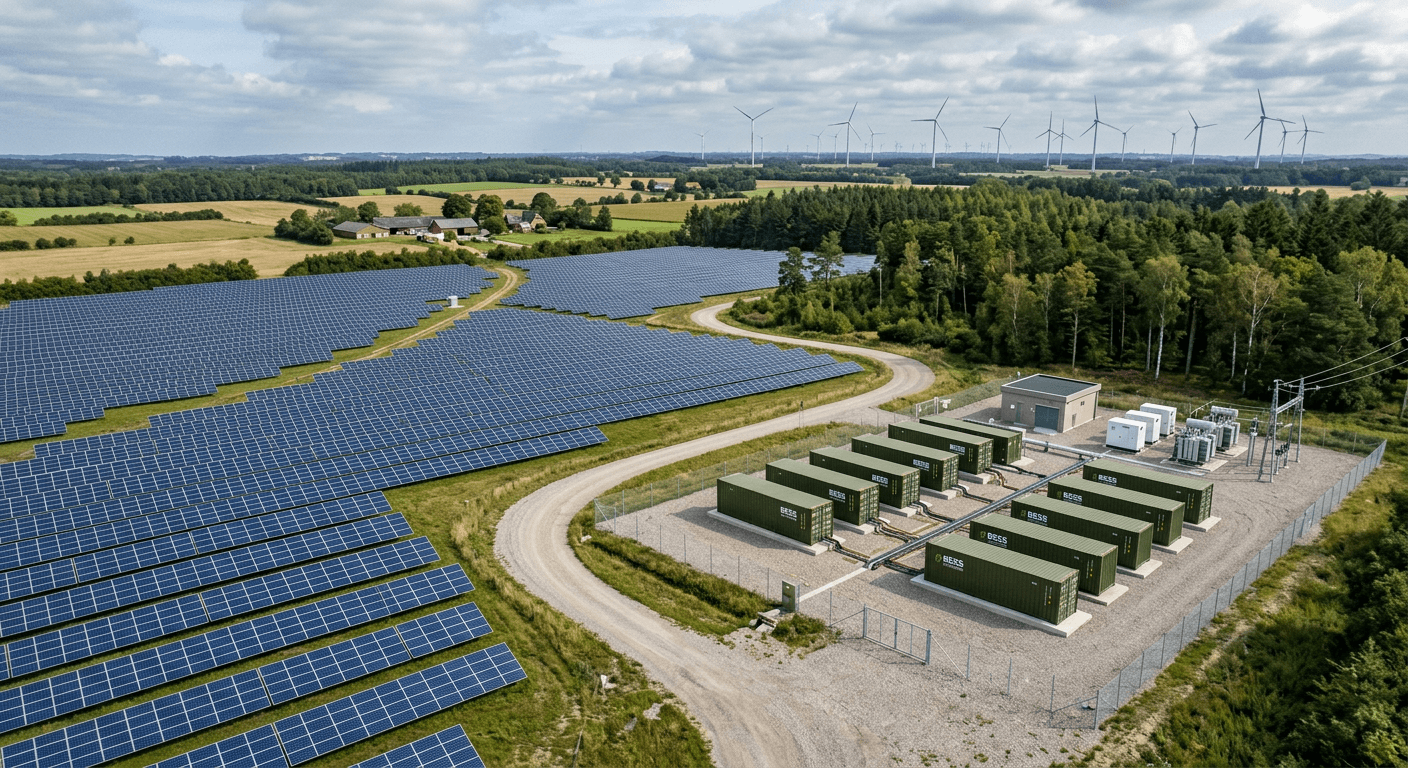
If you're developing or operating a wind or solar project in the Nordic region, you've likely considered adding battery storage. But here's what many project developers miss: relying solely on energy arbitrage leaves significant revenue on the table.
Co-located batteries—those installed at the same grid connection as renewable generation—can access a stack of revenue streams that dramatically improve project economics. In Nordic markets, ancillary services typically account for 70-90% of battery baseline revenues, with energy arbitrage playing a supporting role.
In this article, you'll learn:
Which revenue streams co-located batteries can access beyond arbitrage
Technical and market requirements for each service (with Denmark-specific details)
How to evaluate whether revenue stacking makes sense for your project
Common mistakes that erode returns
What Revenue Stacking Actually Means
Revenue stacking means using a single battery asset to earn income from multiple sources—rather than dedicating all capacity to one market. Instead of choosing between frequency regulation OR energy arbitrage, you do both (and potentially more).
Two approaches exist:
Static allocation: Reserve fixed percentages of capacity for each service. Simple to manage, but less responsive to market conditions.
Dynamic optimization: Real-time reallocation based on current prices and opportunities. Higher potential returns, but requires sophisticated energy management systems.
Research shows the difference matters. For solar co-located batteries, cross-market optimization achieves approximately 25% capture price improvement compared to around 8% for arbitrage-only operation. The gap is smaller for wind—8% vs. 3%—but still meaningful over a 15-year asset life. [ESTIMATE: Based on single study; actual results vary]
The Revenue Stack: What's Available
Frequency Containment Reserves (FCR)
FCR is the workhorse revenue stream for Nordic batteries. These services maintain grid frequency around 50 Hz by automatically adjusting power output in response to frequency deviations.
FCR-N (Normal operation): Symmetric service for normal frequency fluctuations. Your battery responds proportionally to frequency deviations within ±100 mHz. Activation time: 2-3 minutes.
FCR-D (Disturbance): Asymmetric service that kicks in when frequency drops below 49.9 Hz (indicating a generation shortfall). Full activation required within 30 seconds. More demanding technically, but historically well-compensated.
What makes FCR attractive: Capacity payments—you get paid for being available, not just when activated. This provides predictable baseline revenue.
The catch: FCR is a symmetric or partially symmetric service, meaning you need to maintain SOC buffers. Denmark requires reserving 25% of capacity for FCR energy management (PNEM), and 20% for FCR-D.
Automatic Frequency Restoration Reserve (aFRR)
aFRR operates on a TSO-controlled setpoint signal. Unlike FCR (where your battery responds autonomously to measured frequency), the TSO tells you exactly how much to increase or decrease output.
Market structure: Daily capacity auction with 1 MW minimum bids. Pay-as-cleared pricing. In DK2, the market has been operational since December 2022; DK1 joined in October 2024.
Why it's growing: As more batteries enter FCR markets and prices compress, aFRR offers diversification. Nordic TSOs project balancing capacity needs will double in some areas by 2030.
Challenge: DK2's aFRR market has limited liquidity and high entry barriers, leading to price volatility. [VERIFY: Current liquidity conditions]
Manual Frequency Restoration Reserve (mFRR)
A major market change occurred in March 2025: Nordic mFRR shifted from 60-minute manual activation to 15-minute automated activation. This transformed mFRR into a viable battery revenue stream.
New specifications:
Full activation time: 12.5 minutes
Minimum bid: 1 MW
15-minute settlement intervals
Revenue structure: Both capacity payments (for availability) and activation payments (for energy delivered). The largest market by MW volume among Nordic reserves.
Intraday Trading
European intraday markets offer growing opportunities. EPEX intraday volumes reached 215 TWh in 2024 (+22% year-over-year), while Nord Pool intraday hit 114 TWh (+50%).
What drives value: Price volatility. Germany recorded 724 negative price hours in 2025. Denmark sees average daily spreads around €110/MWh—lower than Germany but still meaningful. [VERIFY: Current spread data]
For co-located batteries: Charge during low/negative price hours when renewable generation peaks, discharge during evening demand peaks. The strategy complements reserve obligations that occupy capacity during other hours.
Curtailment Reduction (Co-Location Specific)
This revenue stream only exists for co-located systems. When renewable generation exceeds grid export limits, a standalone solar or wind farm must curtail—wasting energy. A co-located battery captures this energy instead, storing it for later sale.
Research suggests curtailment reduction can recover up to 70% of otherwise lost generation. [ESTIMATE: Results vary significantly by project configuration]
Co-location economics matter here: Studies show co-located solar projects capture around 72% of their locational price, versus 57% for standalone installations.
Requirements to Participate
Prequalification (Denmark)
Before accessing ancillary services, you need TSO prequalification. In Denmark, this involves:
Frequency measurement: Install a local meter measuring grid frequency at 1-second resolution
Documentation: Submit technical specifications, control capabilities, communication setup
Testing: Demonstrate response capability to Energinet's satisfaction
Telemetry: Establish real-time data connection to the TSO
Renewal: Reevaluate every 5 years minimum
Portfolio flexibility: Prequalified portfolios can extend capacity by 25% (max 10 MW) without new prequalification.
P90 rule: For resources with stochastic output (like batteries paired with wind/solar), Energinet accepts 10% probability that sold capacity won't be available.
Technical Capabilities
Service | Response Requirement | Notes |
|---|---|---|
FFR | <1.3 seconds | Fastest response |
FCR-D Dynamic | 2.5s initialization, 30s full | 86% of response achieved |
FCR-D Static | 30 seconds | Cannot regulate continuously |
FCR-N | 2-3 minutes | Symmetric response |
aFRR | Per TSO signal | Automatic setpoint following |
mFRR | 12.5 minutes FAT | 15-minute intervals |
Your inverter and control system must meet these response times. For FCR-D Dynamic, you need sub-second measurement and control capability.
SOC Management
This is where stacking gets operationally complex. Different services have conflicting energy requirements:
FCR-N: Symmetric, so SOC averages out—but you'll see daily drift
FCR-D: Asymmetric (upward), meaning SOC trends down during activations
Arbitrage: Wants full SOC range to maximize spread capture
Denmark's PNEM requirements help: you must reserve 20-25% of capacity for energy management anyway. But you'll still need an energy management system (EMS) that coordinates across services.
Research indicates that degradation-aware dispatch strategies can reduce battery aging by 10-15% under stacked operation—worth considering in your EMS design.
Sizing for Revenue Stacking
The right battery size depends on your stacking strategy and grid connection constraints.
MW vs MWh Decision Matrix
If you prioritize... | Size toward... | Typical ratio |
|---|---|---|
Frequency reserves (FCR, aFRR) | Higher MW | 1:1 to 1:2 |
Arbitrage/intraday | Higher MWh | 1:2 to 1:4 |
Curtailment capture | Match renewable peak | 1:2 typical |
Balanced stacking | Middle ground | 1:2 most common |
Co-location rule of thumb: Many projects size batteries at 20% of renewable capacity with 2-hour duration. This balances multiple revenue streams without oversizing CapEx.
Grid connection constraint: If your solar farm has a 50 MW connection, you can't export 50 MW of solar AND 10 MW from the battery simultaneously. This limits arbitrage potential during renewable peak hours—but you can still earn from reserves.
Economics: How to Think About ROI
Revenue Potential
Ancillary services dominate Nordic battery revenues today: 70-90% of baseline for projects in Sweden and Finland. However, average prices have declined significantly. Volume-weighted average clearing prices in 2024 were approximately one-third of 2022-2023 levels in some segments. [VERIFY: Current price levels]
IRR improvement from stacking: Industry estimates suggest 3-4 percentage points improvement versus single-service operation. Co-location adds further benefit from shared infrastructure (15-40% CapEx reduction) and curtailment capture. [ESTIMATE: Results are highly project-specific]
Cost Drivers
Battery CapEx: Approximately €600k/MW [ESTIMATE: varies by chemistry, duration]
Infrastructure savings (co-location): 15-40% reduction vs. standalone
Grid fees: Can reach €56K/MW annually in some markets (Netherlands example); co-location shares this burden
PNEM requirement: 20-25% of capacity reserved, reducing tradeable volume
Degradation: High-frequency FCR cycling accelerates wear; model this carefully
Market Saturation Risk
This is the elephant in the room. Nordic battery capacity is growing rapidly—Swedish capacity alone went from ~100 MW to 400+ MW between 2023 and 2024. More supply means lower prices.
Mitigation strategies:
Diversify across services (don't rely solely on FCR)
Add intraday trading to your mix
Watch emerging DSO flexibility services
Consider geographic diversification across bidding zones
Common Mistakes and Failure Modes
Overestimating revenue based on historical prices. 2022-2023 prices are not coming back; model conservatively.
Underestimating prequalification complexity. Budget 3-6 months and real engineering effort.
Ignoring PNEM requirements. You can't sell 100% of capacity; 20-25% is reserved.
Poor SOC management. Without proper EMS, you'll face penalty exposure and missed opportunities.
Assuming co-location only helps. Grid constraints can limit export during high-price periods.
Single-market dependency. When FCR saturates, revenue drops fast if you're not diversified.
Underestimating degradation. Model cycle costs accurately; FCR can be demanding.
Skipping aggregation evaluation. For projects under 5 MW, aggregator fees may be worth the reduced complexity.
When Revenue Stacking Makes Sense (and When It Doesn't)
Stack aggressively if:
Project scale > 5 MW (or using aggregation)
Grid connection is export-constrained
You have sophisticated EMS/trading capability
Multiple liquid markets accessible
Long-term view with diversification priority
Battery duration ≥ 2 hours
Consider simpler approach if:
Very small project (<1 MW without aggregation)
Limited operational capability
Single dominant high-value market available
Short-duration battery (<1 hour)
Simplicity outweighs marginal revenue gain
Getting Started: Implementation Path
Phase 1: Assessment
Evaluate grid connection capacity and constraints
Analyze local market opportunities (FCR, aFRR, arbitrage spreads)
Model revenue scenarios with conservative price assumptions
Determine optimal battery sizing
Phase 2: Development
Select battery technology and EMS provider
Begin Energinet prequalification process [VERIFY: Current timeline]
Integrate with renewable project controls
Establish trading relationships or aggregator contracts
Phase 3: Operations
Complete prequalification testing
Start with simpler services (FCR-N) before adding complexity
Optimize stacking strategy based on actual market data
Monitor degradation and adjust dispatch accordingly
Frequently Asked Questions
Q: Can batteries participate in multiple markets simultaneously? A: Yes, but capacity committed to one service isn't available for others. Static allocation reserves fixed percentages; dynamic optimization reallocates in real-time. Both approaches require careful SOC management.
Q: What's the minimum battery size for ancillary services? A: Most Nordic markets have 1 MW minimum bid sizes. Smaller batteries can participate through aggregators who pool assets to meet minimums.
Q: How long does prequalification take? A: Typically 3-6 months from application to market entry, depending on testing schedules and documentation completeness. [VERIFY: Current Energinet timelines]
Q: Does co-location limit revenue vs. standalone batteries? A: It changes the revenue profile. You may capture less pure arbitrage (export constraints during peaks), but gain curtailment value and shared infrastructure savings. Net effect is typically positive.
Q: What happens if I can't meet reserve obligations? A: Penalties apply for non-delivery during activation events. These can significantly erode revenues. Robust SOC management and realistic capacity commitments are essential.
Q: How is the mFRR market different after March 2025? A: It shifted from 60-minute manual to 15-minute automated activation. Full activation time is now 12.5 minutes. This creates new opportunities for batteries but requires faster operational response.
Q: Should I use an aggregator or pursue direct market access? A: Direct access offers higher revenue (no fees) but requires prequalification, trading capability, and operational infrastructure. Aggregators simplify entry but charge fees. For projects under 5 MW, aggregation often makes sense.
Conclusion
Co-located batteries can access revenue streams well beyond energy arbitrage—frequency reserves, aFRR, mFRR, intraday trading, and curtailment capture. In Nordic markets, this revenue stacking typically drives 70-90% of baseline returns.
But capturing this value requires:
Meeting technical requirements (response times, frequency measurement, telemetry)
Navigating prequalification processes
Managing SOC across conflicting service demands
Monitoring market saturation and diversifying accordingly
The projects that succeed are those that approach stacking strategically—matching battery sizing to their service mix, investing in capable EMS, and staying responsive as markets evolve.
Ready to evaluate revenue stacking for your renewable project?
Request a feasibility assessment to understand which revenue streams your co-located battery could access—and what returns are realistic in current market conditions.