

Auxilium Infrastructure Partners' perspective on the next phase of BESS deployment in Denmark and the wider Nordic region.
The conventional question in battery investment is which revenue stream comes next. After fast-response ancillary services compress, where does the value go? The framing is reasonable but limiting. It assumes the asset itself remains broadly the same and only the markets evolve around it. The more consequential shift, in our view, is on the asset side. What batteries are deployed for — and how they are configured to deliver it — is changing more rapidly than the markets they serve.
The first phase of Danish battery deployment was defined by standalone merchant assets sized and located to capture fast-response reserve products. This was a rational starting point: scarcity pricing in FCR and aFRR, low capital intensity per MW relative to alternatives, and a regulatory framework that made participation straightforward. Returns were driven by market access more than by configuration. Project design, on the whole, followed the revenue stack rather than shaping it.
The second phase, now broadly underway, extends the asset profile to longer-duration storage routed across multiple markets. We have written previously about the economic rationale for this transition. As fast-response products saturate, value migrates toward sustained balancing, day-ahead arbitrage, and — ahead of the Nordic region's planned MARI accession — mFRR energy activation. This is the current frontier of merchant BESS strategy in DK1 and DK2.
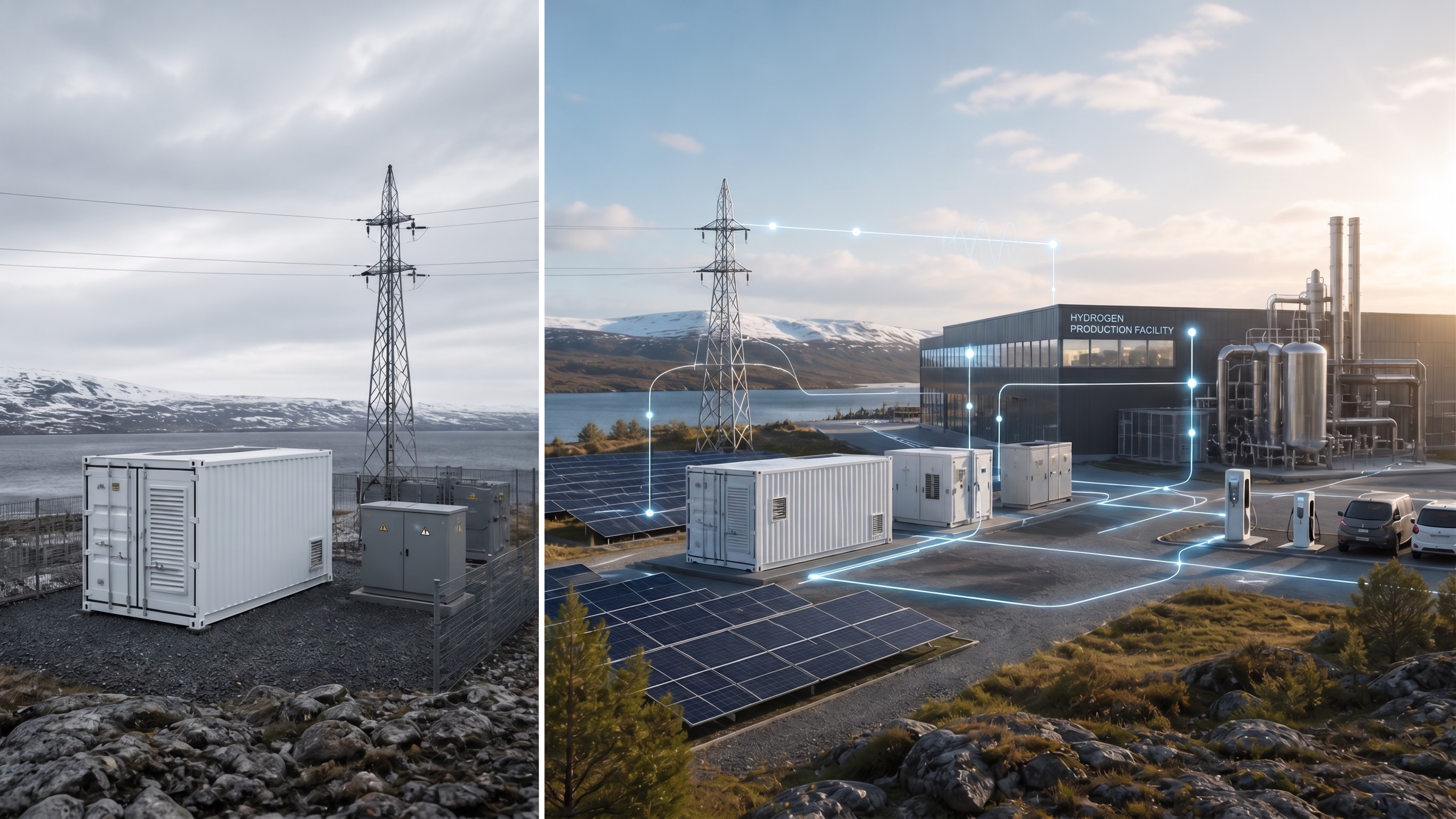
A third phase is emerging behind both, and we believe it will define returns over the next decade. In this phase, the battery is no longer a standalone trading instrument. It is one component of an integrated site — co-located with renewables, with commercial and industrial load, or with sector-coupling assets such as electric boilers and depot charging — and its value is determined as much by what it enables on the same grid connection as by what it earns in the wholesale and reserve stack. Several structural forces are driving this evolution, and each carries a specific implication for how new projects should be designed.
Grid connection capacity is now the binding constraint in much of Denmark. The pause on new connection offers introduced in early 2026 has formalized what was already visible in queue data: physical access to the grid is scarcer than the cells, inverters, or capital required to build behind it. This shifts the design optimum from MW per site toward value per MW of connection, and rewards a hybrid-ready topology — connection and power conversion architecture sized from the outset to host PV, electric boilers, and commercial loads behind a single grid point. A connection that hosts a stacked configuration earns more, and is more defensible against re-rating, than one that hosts a single asset class.
Corporate decarbonization is producing a parallel pull on the same design choice. Electrification of heat, fleet, and process is moving from policy ambition to procurement decision across Danish industry. These loads do not behave like legacy industrial demand. They are flexible, weather-correlated, and economically dependent on intra-day price signals. Behind-the-meter battery capacity is increasingly the bridge between corporate electrification commitments and their operational economics, and the basis for long-term offtake structures that anchor financeable returns. The integrated site, not the standalone battery, is becoming the unit that institutional capital underwrites.
System service requirements from the TSO add a third vector, and this one bears directly on the hardware specification. As thermal generation exits the Nordic system, inertia, short-circuit level, blackstart capability, and grid-forming services migrate from passive byproducts of synchronous machines to procured products. Capturing them is a hardware question. Storage capacity, response time, and power conversion rating engineered above current market needs preserve the asset's position in these layers as they mature. Grid-forming capability at the power conversion stage further separates batteries able to deliver blackstart and islanding from those structurally limited to energy and frequency products. Both are straightforward to specify at commissioning and economically difficult to retrofit once the asset is in service.
Finally, the asset itself is becoming software-defined. The same hardware platform can participate in markets that did not exist when it was commissioned, provided the control layer was designed to accept new products. MARI accession, the next iteration of frequency reserves, and TSO products that have not yet been specified will reward assets whose software architecture was designed for them, and strand those whose was not. This is a design-stage decision with structural consequences for asset relevance over a 15- to 20-year operating life.
Taken together, these choices reposition the battery as one component of an integrated system asset rather than a single-purpose trading instrument — and align the asset with the direction the Nordic system is heading rather than the markets it has historically served.
For investors, the implication is a corresponding shift in underwriting. Standalone merchant BESS will remain a workable but increasingly marginal proposition. The premium accrues to assets embedded in load and renewable ecosystems, where the operator controls origination, connection rights, and the integration between components. The moat is no longer procurement of cells or access to standardized reserve markets; it is the customer relationship and the engineering integration behind it.
At Auxilium Infrastructure Partners, this is the framework we apply when developing and operating sites across DK1 and DK2. We are always interested in discussing our perspective with investors, corporates, and partners navigating this transition.