
Power Trading Is Moving From Prediction to Control — And Asset-light Desks Are On The Wrong Side Of It

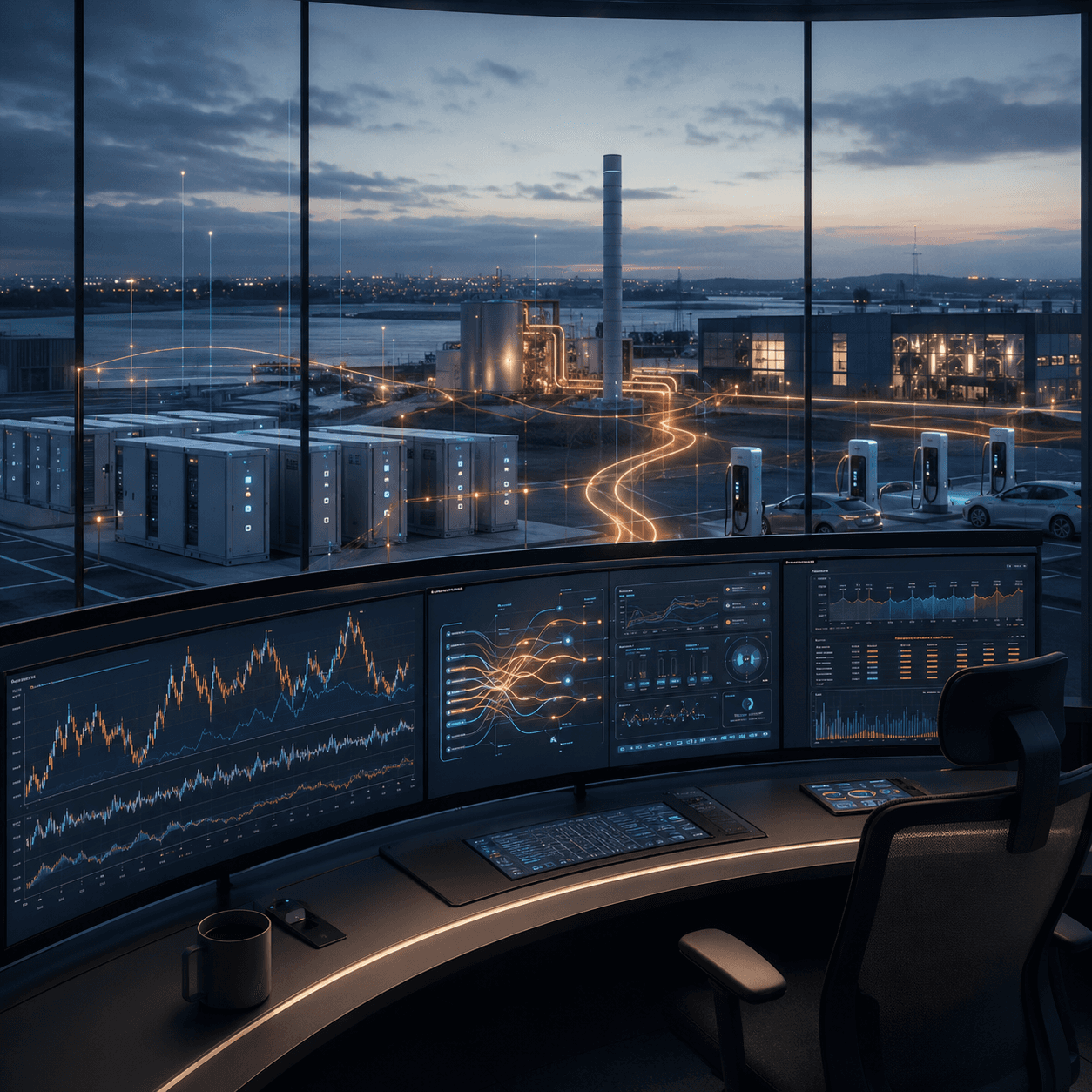
Auxilium Infrastructure Partners’ perspective on why the next generation of power-market winners will be flexibility platforms, not forecasting desks.
Europe’s power market is becoming more volatile, and on the surface that looks like good news for traders. Renewable build-out is accelerating — the IEA expects variable renewables to reach 46% of EU generation by 2030, up from 30% in 2025 — bringing sharper intraday swings, more frequent negative prices, deeper forecast errors, and more valuable scarcity hours. More volatility should mean more opportunity.
But volatility and capturable margin are not the same thing. The gap between them is where the industry is quietly repricing.
Power markets are more volatile — and more efficient
For decades, power trading earned its returns from four edges: better forecasting, better market access, faster execution, and a stronger balance sheet. All four still matter. None is as proprietary as it was.
Weather data, TSO signals, generation forecasts, and outage information are increasingly commoditised. Automated bidding and short-term optimisation are becoming standard. And market design itself is tightening: in late 2025, the EU day-ahead market moved from hourly to 15-minute trading intervals, letting prices track system conditions far more closely.
That is good for the system — and it competes away precisely the structural inefficiencies asset-light desks used to harvest. A trader without physical optionality is left competing on prediction alone. That is a hard position to defend.
Reserve markets show how fast a profit pool can compress
Balancing and ancillary-service markets make the dynamic concrete. Early on, when few assets are prequalified and TSO demand is stable, reserve revenues can be highly attractive. But these are capacity markets: as batteries, aggregators, EVs, and flexible industrial load enter, supply climbs and prices fall.
Denmark is the live example. Energinet expects its system-service costs to fall to around DKK 1.5 billion in 2026, down from just over DKK 2.1 billion in 2025 — a saving of nearly DKK 650 million — as new actors and technologies sharpen competition in the reserve markets.
This does not make reserve markets unattractive. It means they cannot be treated as static revenue pools. First movers capture the excess return; capacity follows; margin compresses; and value shifts to whoever can optimise across day-ahead, intraday, balancing, ancillary services, and grid services at once. That requires more than market access. It requires flexible assets.
Flexibility is the scarce resource
The system increasingly needs assets that respond to price. A battery charges when prices are low or negative and discharges when they spike. An e-boiler turns surplus power into heat. EV charging shifts; industrial load moves. Each creates optionality — a choice between revenue streams as conditions change. A pure trader can forecast a spread. An asset-backed trader can physically capture it.
There is an information dimension too. The asset owner sees both the price signal and the physical constraint — state of charge, degradation cost, grid limits, whether production can actually shift — while the external trader sees only the price. Over time, that asymmetry drives adverse selection: the best opportunities stay with those who hold physical control, while the commoditised ones are left to the open market.
Control, not ownership
The conclusion is not that every trading house must become an asset-heavy utility. Ownership is one route, but it is not the point. The point is the contractual right to dispatch and monetise flexibility — through ownership, joint ventures, tolling agreements, BSP/BRP and portfolio arrangements, or the aggregation of many small units.
The common denominator is control. A trading company with no assets and no dispatch rights is a forecasting business. A trading company with access to flexible assets is an optimisation platform. As markets grow more efficient, that distinction separates durable margins from disappearing ones.
Where the winners will sit
The next generation of power-market leaders will combine five things:
market access across all timeframes;
physical flexibility;
dispatch-optimisation software;
portfolio scale across geographies and technologies; and
the balance sheet to trade volatility responsibly.
That profile looks closer to a virtual power plant than to a traditional trading desk — but with real commercial and financial integration. The prize is no longer simply to buy and sell electricity; it is to orchestrate flexibility across the system.
Put simply: the future of power trading belongs less to those who can predict volatility, and more to those who control the assets that respond to it.
Auxilium Infrastructure Partners operates at exactly this intersection — developing and optimising battery storage and industrial flexibility across DK1 and DK2, where trading capability and physical control meet. We are always open to a conversation with investors and partners thinking about where this market is heading.